
Douglas County Release Records
Release from the Douglas County Correctional Facility means that one episode of county custody ended. It does not always mean the person walked into the community. The Douglas County Sheriff’s Office may have discharged someone on bond, after time served, following dismissal or a judge’s order, into pretrial supervision, or to another custodian. A move to the Kansas Department of Corrections, another county, federal authorities, or immigration custody is a transfer. The person remains confined even though the Douglas County jail event has closed.
The live DGSO In Custody Report answers who is currently carried in Douglas County custody. Once a release event posts, the name should leave that report. The underlying booking can remain on the 14-day Booking Recap, while the jail-management record and court file preserve different parts of the event. Kansas VINE may report the custody change. KASPER becomes relevant only if the person entered Kansas state corrections. Each system has a narrow role, so a reliable answer joins identifiers and dates across records.
A missing name is a lead, not a release record. Confirm whether the event was community release, transfer, or a change in where the person is housed.
How Douglas County Custody Ends
Douglas County reports several charge-level release categories, but one person can have more than one charge and more than one reason recorded. A bond order authorizes release subject to its terms; it is not an acquittal and does not show when staff finished discharge processing. Time served reflects a sentence or credit decision. Dismissal or no filing concerns prosecution. Own-recognizance release, often called OR release, does not require a cash bond but may carry conditions. House arrest and supervised pretrial release keep a person under rules outside the jail.
| Release event | What it means | Best next record |
|---|---|---|
| Bond or OR | County custody may end while the case remains open. | Court bond order, DGSO release time, Kansas VINE |
| Time served | A sentence or credited jail time supports discharge. | Journal entry and jail release event |
| Dismissed or not filed | The cited charge did not proceed or was dismissed. | Controlling district or municipal court file |
| Probation or supervision | The person is outside jail under court or agency conditions. | Court case, supervising office, or KASPER |
| Transfer | Douglas County custody ended, but another agency took custody. | Receiving agency, KASPER, BOP, or ICE locator |
Release date, reason, and destination must stay separate. “Released to KDOC” records a county release event, yet it is not release to the community. A VINE alert can mark a change without explaining its legal basis. The court supplies authority, while DGSO supplies the operational time and recorded destination. Review every case and hold because release on one matter may leave a municipal warrant, another-county hold, state warrant, federal writ, or immigration transfer unresolved.
Douglas County Release Record Fields
A useful Douglas County release request ties one person and one booking to the event that ended custody. The public reports do not provide that full set. In Custody has identity, agency, and location data but no release fields. Booking Recap contains detailed arrest, charge, court, judicial-status, and bond data, yet it omits release date, release reason, and a current-custody flag. Ask for the jail event itself and use the court file to explain the legal basis.
| Requested field | What it establishes |
|---|---|
| Full name, aliases, DOB | Identity match for the person |
| CHRI/Inmate and booking numbers | Link among DGSO reports, VINE, and the booking |
| Admission and release date/time | Start and end of the county custody episode |
| Arresting agency, court, case number | Office and tribunal controlling the matter |
| Release disposition or reason | Recorded basis for ending county custody |
| Receiving agency or destination | Community departure versus continued custody |
| Charges and judicial status | Connection to the case, not proof of guilt |
Douglas County’s public Booking Recap lasts for the previous 14 days based on booking date. That is a web-publication window, not a verified destruction or retention schedule. An older booking released today may already be absent. Court and KDOC records can last much longer, subject to expungement, sealing, confidentiality, and the governing record schedule. The exact language on an individual record controls.
Request Douglas County Release Records
DGSO is the custodian for DCCF booking and release events. Its NextRequest portal is labeled for accident and offense reports, so jail-record coverage is not guaranteed. The safer route is to ask the Public Information Officer or Corrections where a focused jail-management request should go. No current sheriff fee schedule, routine production time, release-record retention period, or categorical booking-photo rule was verified.
- Collect the person’s full name, aliases, date of birth, CHRI/Inmate number, booking number, agency, court, case number, and a narrow date range.
- Ask for “the booking/release event record showing admission date and time, release date and time, release disposition or reason, and receiving agency or destination, if recorded.”
- Request a booking photograph separately. Identify its booking number and date, and ask about current policy, format, redaction, retention, and cost.
- Ask for electronic delivery and a cost estimate before work begins. If material is withheld, request the cited legal basis and any segregable public portion.
- Compare the response with the official court case. A jail event gives timing; the judgment, dismissal, bond, probation, or commitment order gives legal context.
Corrections: 3601 E. 25th Street, Lawrence, KS 66046
785-830-1000 | Fax 785-830-1085
Public Information Officer: 785-832-5113
Kansas law provides a response framework, not a promise that every field will be produced in three business days. A timely response may state that more time or payment is needed. KDOC, the court clerk, BOP, and ICE each control their own records. Send the request to the agency that created the event rather than asking one office to reconstruct another agency’s file.
Kansas Law on Douglas Releases
The Kansas Open Records Act governs agency access with important limits. K.S.A. 45-218 addresses access procedures and inspection. K.S.A. 45-219 allows reasonable fees and advance payment. Its copying terms do not create a broad duty to duplicate every photograph. K.S.A. 45-221 identifies records that may be closed or protected by other law.
Juvenile, medical, security-sensitive, investigative, victim, expunged, sealed, and otherwise protected information may be restricted or redacted. Expungement is a court process, not an automatic result of release. A sealed case may no longer appear in public search, so absence does not prove no case existed. Ask the clerk about access rules without seeking protected content. A booking record shows processing, not guilt; the official case file supplies disposition.
Douglas County Bond Release Timing
Douglas County’s release-decision path starts with the correct court and every active hold. District first appearances are scheduled at 3 p.m. on weekdays other than federal holidays. A judge may order OR release, cash or surety bond, or supervised conditions. County pretrial services and electronic monitoring are described as no cost to the defendant, although a judge may still impose money bond. DGSO’s bond information lists GovPayNet Pay Location Code 7014 and requires the defendant’s name, date of birth, CHRI number, and amount.
Payment does not prove release was completed. Staff may still need to confirm identity, process property, check other cases, and resolve holds. A court order shortly before the four-hour roster refresh can leave a person visible until the next update, and an order in one case may not clear another. Use Kansas VINE and Corrections for the event time. The court docket remains the best source for the order and its conditions.
How Fast Douglas Releases Occur
Douglas County’s 2025–2027 criminal justice strategic plan provides local context, not a named-person lookup. It reports that 56 percent of releases occurred within one day, 25 percent in the first week, 9 percent in the first month, and 10 percent later. The estimated average stay for 2024 was 16.8 days. Those figures cannot predict an individual release because charges, court orders, sentence credit, holds, and administrative processing differ.
The plan warns that release reasons are calculated at the charge level, allowing one person to contribute more than one reason. It also flags unclear dashboard definitions and totals. Event counts are not counts of unique people. Use the plan to understand the local flow, never to infer what happened in one booking.
Find Douglas County Released Inmates
The strongest Douglas County released inmate search uses affirmative records instead of a roster no-result. Start locally, carry the CHRI or Inmate number between systems, and change tools only when the custody path requires it. The DGSO Inmate Reports hub explains the public reports and their four-hour update cadence.
- Search In Custody by name or number. Save the displayed Inmate number, agency, and location. A match means Douglas County still reports custody, even if the person is housed elsewhere.
- Search Booking Recap by last name or booking number. Match DOB, CHRI number, arrest date, agency, court, and case number. The recap proves a booking, not release.
- Check Kansas VINE by identifier or name and read the agency, status, and event wording. Call 866-574-8463 if the web result is unclear.
- Call DCCF Corrections at 785-830-1000. Ask whether the booking ended, when it ended, and whether the event was community release or transfer.
- Open the controlling court case. Use its bond, dismissal, judgment, sentence, probation, revocation, or commitment entries to explain the legal outcome.
- Use KASPER for state custody, BOP for a federal sentence, and ICE for immigration custody. If the trail remains incomplete, request the precise DGSO release event.
The search path also covers old events. Once Booking Recap ages out, use the court portal, courthouse terminals, clerk request, DGSO request, and KASPER if state incarceration occurred. The Douglas County court-record page routes users to the state portal, local request form, and public terminals.
KASPER Douglas Release Search
KDOC explains that KASPER covers people currently incarcerated and those released or discharged from Kansas correctional facilities since 1980. That makes it useful after a Douglas County sentence leads to state prison. It is not a complete archive of short DCCF stays. A person who never entered KDOC may have no KASPER record.
The official locating page below documents that released and discharged population coverage. It supports a state-corrections search, not a claim that every Douglas County jail release appears there.
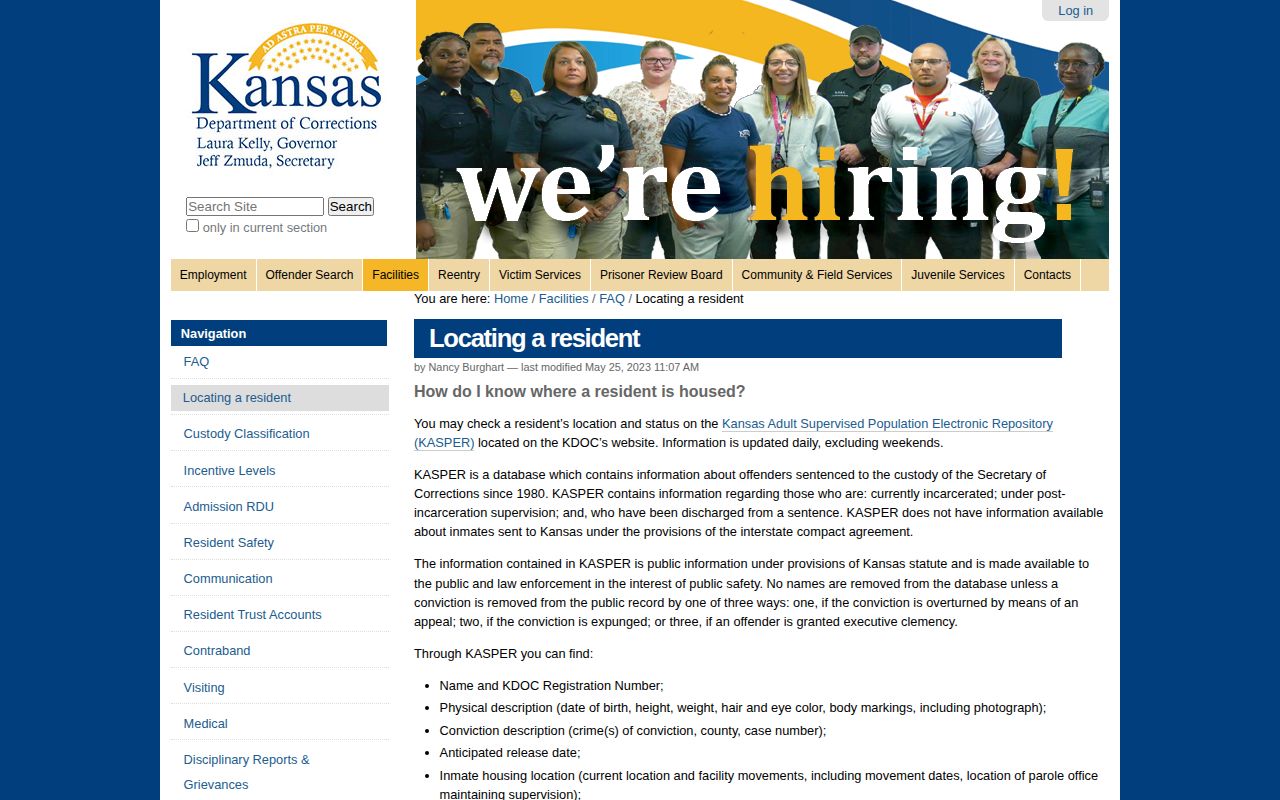
Use the KDOC number when available, then compare name, date of birth, descriptive data, conviction details, and location before selecting a result. Read status, sentence, supervision, and movement or release data together. “Released” from prison can mean supervised release; “discharged” generally signals the end of the KDOC sentence relationship. Preserve the exact public label and date.
| KASPER field group | How to read it |
|---|---|
| KDOC number, name, aliases | Primary identity match |
| DOB and descriptive details | Checks a same-name result |
| Conviction and sentence | Connects the person to state custody |
| Status and location | Shows custody, supervision, or other reported state |
| Movement and release data | Records state events; labels vary by record |
| Offender photograph | KDOC image, not necessarily the DCCF booking photo |
KASPER updates each working day. Weekends, holidays, transfers, and entry work can delay a change. A projected, conditional, eligibility, release, or discharge date is not interchangeable with the others. The exact record must support the term. Official documentation can be requested from KDOC under its KORA process.
Douglas County Recent Release Limits
DGSO does not publish a verified 24-hour, 72-hour, or general recent-release feed. Its official menu provides In Custody, Booking Recap, and Bond Amounts. In Custody shows current custody. Booking Recap shows bookings in the previous 14 days. Bond Amounts concerns outstanding bonds. None supplies a release date, reason, destination, or booking photo.
The official report-hub image shows the available Douglas County choices and their update pattern. It should not be read as evidence that a hidden release list exists.
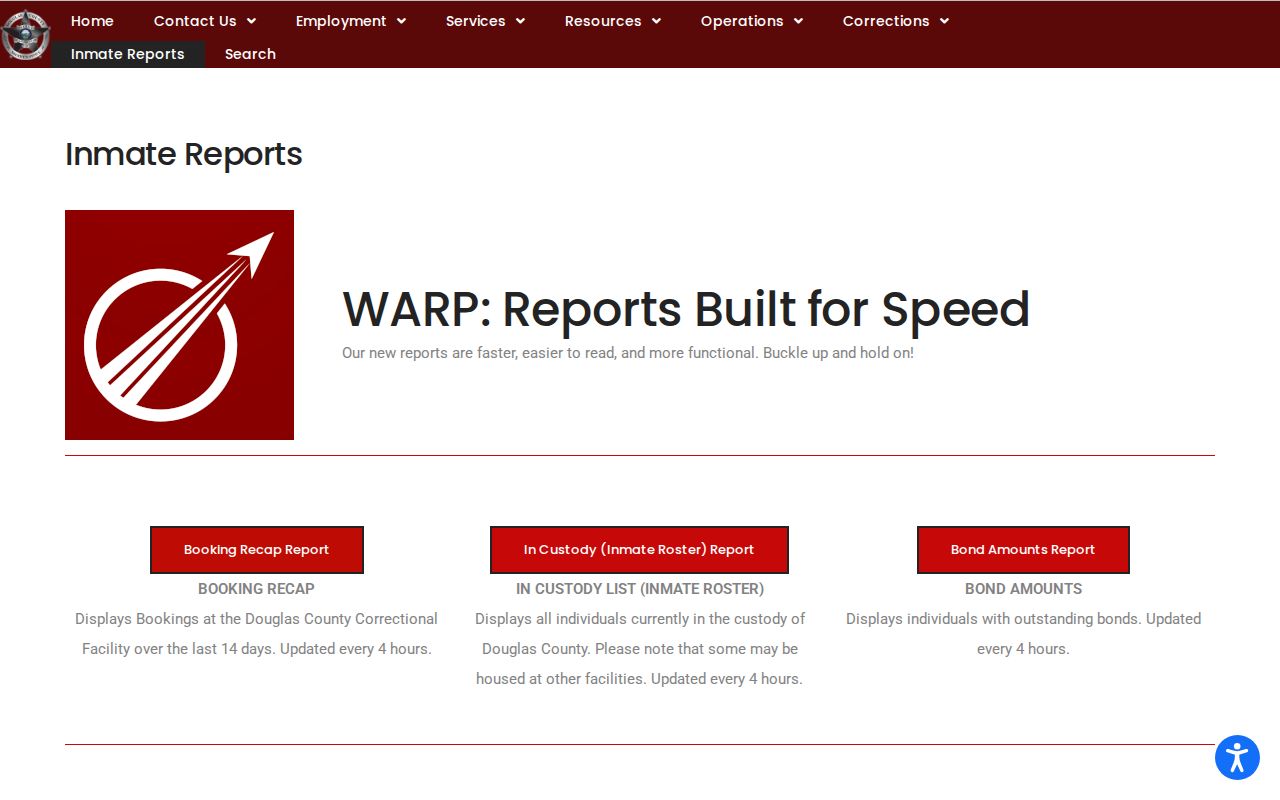
Comparing a recent booking with the current roster can flag a possible departure, but it cannot prove when or why custody ended. A person booked months earlier and released today may not be in the booking window at all. Use VINE, Corrections, the court, and a focused release-event request. The resolved Jail Releases: 24 Hours page applies that fallback to same-day questions.
Douglas Release Court Case Routing
The Seventh Judicial District is separate from Lawrence, Baldwin City, and Eudora municipal courts. Booking Recap exposes both the Court and Court Case # fields, which form the bridge from a vanished jail entry to a durable disposition record. Search the named tribunal. A district court search will not necessarily resolve a municipal case, and one person can have matters in several courts.
The county court page pictured below offers the Kansas portal, local request route, and public access terminals. Douglas County warns that a response generated from multiple sources is not itself the official complete case record under Kansas Supreme Court Rule 106B.
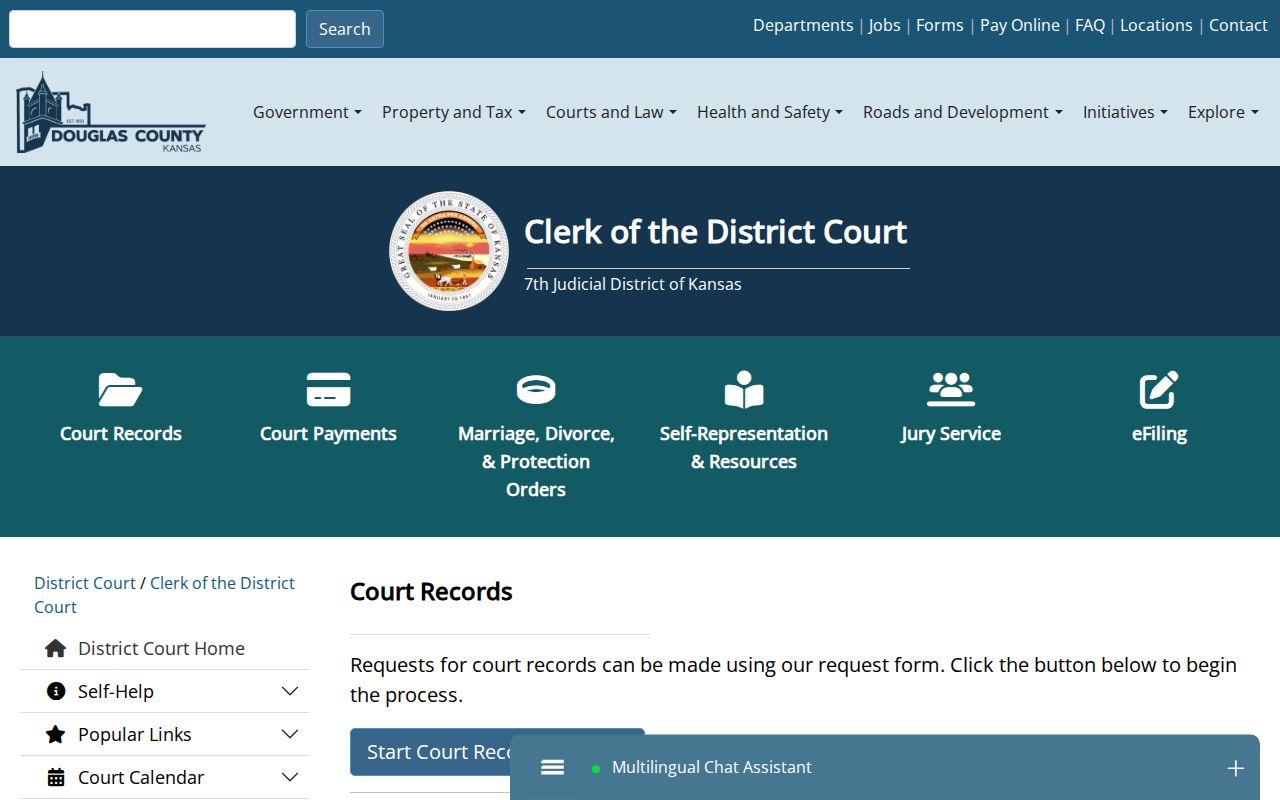
Look for the bond order, dismissal, plea, judgment, sentence, probation, revocation, commitment, and satisfaction entries. A court order provides legal authority but may not show when jail processing finished. Pair it with the DGSO event. Public terminals are in the clerk’s office at 111 E. 11th Street in Lawrence.
Douglas Release Supervision Check
Parole, postrelease supervision, county probation, and pretrial supervision are different. KDOC Parole Services may supervise a person leaving Kansas prison. Court services or community corrections may supervise county probation. Pretrial services operate before a final disposition. The sentencing authority and exact record determine which applies.
- Parole
- Conditional release from an eligible prison sentence under state supervision.
- Probation
- A court-ordered community sentence with stated conditions.
- Postrelease supervision
- A supervision term following prison under the governing Kansas sentence.
- Discharge
- The reported end of the controlling sentence or supervision relationship.
KASPER can show a state offender’s public status and supervising location. Probation is best confirmed in the district or municipal court case and with the named office. Absconder status indicates reported loss of contact or noncompliance, not sentence discharge. No searchable DGSO warrant list was verified. The Douglas County Probation & Parole page separates these channels.
Douglas County Reentry After Release
DGSO operates a local reentry program with short-term goal work and intensive case management that may continue for up to 180 days after release. Published intensive criteria include a sentence longer than 30 days, Douglas County residence, a reached disposition, and no detainers or warrants. Those limits mean the service is not available to every released person.
Reentry is not a custody-status or parole lookup. It helps with a transition after the release has been established through DGSO, the court, or KDOC. The Reentry Director is listed at 785-830-1001. DGSO also says letters arriving at DCCF after someone has been released are returned to sender. Mail does not follow the person, but postal handling is too slow and indirect to serve as a release alert.
Douglas Release Alerts and Transfers
Kansas VINE is linked by DGSO for custody status and notifications. Match the person with the Douglas identifier crosswalk: CHRI # in Booking Recap, Inmate # in In Custody, and Person # in Bond Amounts. Read the reporting agency and event wording. People housed outside Douglas County may appear more than once. A VINE custody change can show the end of county custody without proving community release.
For federal criminal custody, use the BOP Inmate Locator. A former federal prisoner may show a release date and “Released” or “Not in BOP Custody,” but that status concerns BOP only. U.S. Marshals pretrial custody may not appear there. For immigration custody, use the ICE Online Detainee Locator. A no-result can reflect a data mismatch, processing delay, short covered period, transfer, or protected record. Ask DGSO for the receiving custodian when a transfer is suspected.
Douglas Released or In Custody
The same name can appear in one system and be absent from another because the systems answer different questions. Check legal custody and physical location separately. DGSO warns that its current roster may list an outside housing site for someone still in Douglas County custody.
| Source | Best use | Key limit |
|---|---|---|
| DGSO In Custody | Current Douglas County custody | No release date or reason |
| DGSO Booking Recap | Recent booking and court identifiers | Booking window is not a release list |
| DGSO release event | County release time, reason, destination if recorded | Requires direct confirmation or request |
| Kansas VINE | Custody change and alerts | May not explain the legal reason |
| KASPER | State custody, release, supervision, discharge | Does not cover every county-only stay |
| Court file | Bond, disposition, sentence, probation | Order time may differ from jail departure |
| BOP or ICE | Federal or immigration custody path | Each system has coverage limits |
Douglas County Release Facilities
The Douglas County Correctional Facility is the primary adult booking and detention site. Juvenile detention uses a confidential, court-led process and must not be folded into the adult search. Lawrence, Baldwin City, and Eudora matters commonly route through DCCF but can belong to separate municipal courts. Kansas prison, federal prison, and immigration custody each require their own locator.
- Douglas County Correctional Facility, adult county jail and local release custodian
- Northeast Kansas Regional Juvenile Detention Center, privacy-limited juvenile process
- Lawrence, Baldwin City, and Eudora municipal channels, with no verified separate adult release roster
- Kansas Department of Corrections system, for KASPER state custody and discharge records
- Federal Bureau of Prisons system, for federal sentenced custody
- ICE and federal immigration custody, for civil immigration detention
DGSO says DCCF programming began when the jail opened in 1999. Its homepage also advertises a Public Safety Building opening in 2026, but the effect on the release door, records counter, or address was not verified. Confirm directions before visiting. Corrections remains the authoritative source for current release processing.