
BOP Releases for Douglas County
The Federal Bureau of Prisons is relevant only when a person connected to Douglas County was prosecuted or confined federally. A routine arrest and stay at DCCF belongs to DGSO. A Kansas prison sentence belongs to KDOC. Neither county nor state search should be used as a substitute for the BOP locator when federal prison custody is established.
The BOP Inmate Locator generally covers federal inmate records from 1982 to the present. A former prisoner may appear with “Released” or “Not in BOP Custody” and a release date. That date identifies a BOP event. It does not resolve unrelated Douglas County charges, another state's warrant, immigration custody, or supervision.
Confirm a BOP Release
Use a BOP register number when available because it is more reliable than a name alone. The locator also permits a biographical search. Compare the full name and available age, race, and sex fields. Similar names and spelling variants require caution.
- Search the BOP locator by register number or exact biographical data.
- Match the identity before reading the release field.
- Record the exact status, release date, and search date.
- Check the federal court docket for sentence and later orders.
- Trace any transfer through DGSO, USMS, ICE, or the named receiving agency.
A locator result can include name, register number, age, race, sex, release date, and location or status. Public fields vary. Do not infer a release reason that the result does not state. The federal judgment and docket provide sentencing context, while the agency record supplies the custody event.
The manifest image below matches this page's federal search route.
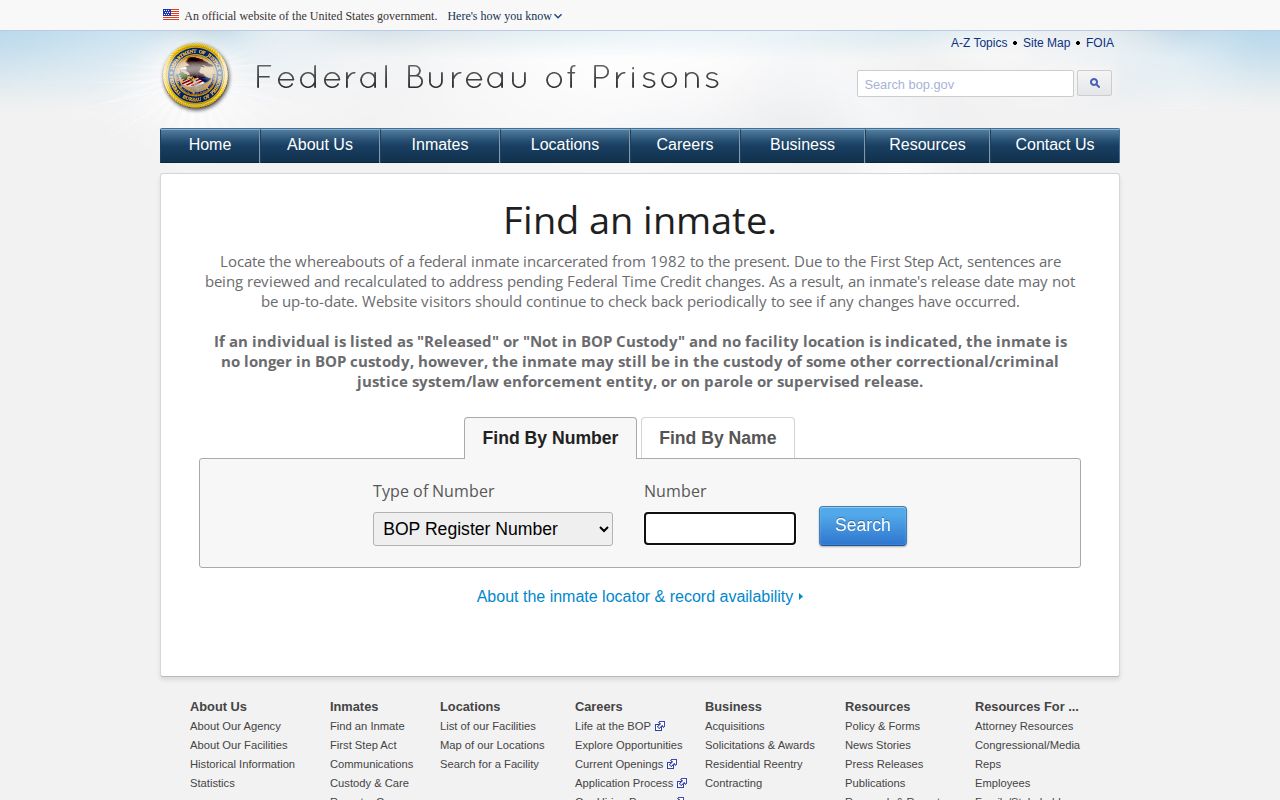
The locator should be searched only after confirming that federal prison custody, rather than county detention or state prison, is the relevant system.
BOP and USMS Differ
The U.S. Marshals Service often holds federal pretrial detainees in local or contract facilities. A person can therefore be in federal custody without appearing as a sentenced BOP prisoner. There is no general public USMS historical inmate locator comparable to KASPER or the BOP tool.
| Custody situation | Best confirmation path |
|---|---|
| Sentenced federal prisoner | BOP locator, BOP record, and federal docket. |
| Federal pretrial detainee | USMS inquiry, federal docket, and holding-facility information. |
| Transfer from DCCF to USMS | DGSO transfer event plus federal case and receiving custodian. |
| Former BOP prisoner | Released status/date plus docket and any supervision record. |
| Immigration detention | ICE locator and ERO, not the BOP locator. |
A BOP no-result does not eliminate federal custody. The person may be pretrial, newly transferred, held under a different identifier, or outside BOP's sentenced population. Ask DGSO for the receiving-agency information when the county event indicates a federal transfer.
Douglas Jail to Federal Custody
A person can first appear in the DGSO current report because a local facility is physically holding them. The arresting or holding agency, court field, and case number help distinguish the matter. If USMS takes custody, removal from the Douglas roster is a transfer, not a community release.
Check the DGSO reports hub and preserve the booking and CHRI identifiers. Request the DCCF release or transfer event showing date, time, disposition, and receiving agency if recorded. Then use the federal docket to verify prosecution status. BOP may become useful only after sentencing and designation.
A county court release order does not resolve a federal writ or hold. Likewise, the end of BOP custody does not dispose of a remaining Douglas County case. Each custodian and court must be checked separately.
Read Federal Release Terms
Federal custody terms are easily blurred. Keep each tied to the source that uses it.
- Register number
- The BOP identifier used to distinguish the federal record.
- Released
- A public BOP status indicating departure from BOP custody, subject to the exact live result.
- Not in BOP custody
- A statement about BOP control only, not every agency.
- Pretrial detention
- Custody before final judgment, often managed through USMS rather than BOP.
- Supervised release
- A federal court-ordered period in the community after imprisonment, distinct from BOP confinement.
The displayed release date should not be called a final discharge date unless the source says so. Federal supervised release can continue after prison. The docket and supervising federal court record provide the term and later changes.
Federal Release Record Sources
The public locator is a starting point, not the complete institutional file. For a formal record, identify the BOP register number, full name, date of birth, facility if known, and desired date range. Ask for the specific existing movement or release record. BOP and USMS use separate federal records processes.
The federal court docket is the durable source for indictment, detention orders, judgment, sentence, and modifications. It does not necessarily show the exact operational moment of prison departure. A probation office record may be relevant after release, subject to federal access limits.
Do not ask DGSO to certify a BOP release merely because the person once had a Douglas County booking. DGSO can confirm its own transfer event. BOP must confirm BOP custody, and the federal court supplies the case context.
When BOP Shows No Result
First recheck spelling, aliases, and register number. Next decide whether the person was ever sentenced to BOP custody. A federal arrest alone does not establish a BOP prison record. Review the federal docket and ask USMS or the holding agency when pretrial detention is possible.
- Confirm the case is federal rather than Kansas state or municipal.
- Check whether the person is pretrial or sentenced.
- Ask DGSO whether departure was to USMS or another agency.
- Use ICE channels if immigration custody is indicated.
- Seek the responsible agency's record rather than infer release from silence.
The Douglas County released inmate search explains how to compare local, state, federal, and immigration systems. A no-result is evidence only that the searched tool did not return a match under the entered terms.
Federal Release Verification Examples
Suppose a DGSO report shows a federal holding agency and the person then disappears. If the federal docket shows a pending case but BOP returns nothing, pretrial USMS custody is more plausible than BOP release. Request the DGSO receiving-agency field and review the detention order. Do not label the roster change as release.
In another case, the BOP locator shows a release date and “Released.” That supports the end of BOP custody on the displayed date. The docket may still show a supervised-release term, and a Douglas County case may remain. State only what the BOP record establishes.
A third result may say “Not in BOP Custody.” The person could have completed the prison term, transferred, or left BOP control through another event. If the distinction matters, seek the movement record and compare the court file. Do not add a destination or reason absent from the source.
Federal Court Release Context
The federal judgment states the term of imprisonment and supervised release. Later docket entries may amend the sentence, revoke supervision, or record another controlling order. The docket is essential context, but it is not an institutional movement log.
A release date can reflect sentence computation, credits, court action, or another authorized event. Read the BOP record with its exact label. Avoid calling a projected date an actual release or treating a historical locator result as current custody.
Keep the register number, federal case number, search date, status wording, and source office together. Those identifiers allow BOP, the court, USMS, and any local custodian to distinguish the same person and event.
Douglas Federal Source Cross-Check
Use the DGSO current report to verify the local location and holding agency. The Booking Recap may preserve the arrest agency and case routing for a recent booking. These local reports cannot establish a later BOP release, but they can show how the person left Douglas County custody.
If DGSO lists an outside housing location, do not assume the person entered BOP. Legal custody and physical location can differ. Ask for the receiving authority and then choose BOP, USMS, KDOC, another county, or ICE. A correct system choice prevents a false release claim based on the wrong locator.
For an older federal event, the county recap may no longer contain the booking. Keep the federal case number and BOP register number. Those durable identifiers are more useful than repeatedly searching a short local booking window.
A careful federal release check names the source, status, event date, and remaining uncertainty. It never turns a locator silence into proof of release.