
Douglas County 72-Hour Release Window
DGSO has no verified 72-hour release list. Its official Inmate Reports hub links a current-custody roster, a 14-day Booking Recap, and a Bond Amounts report. None reports all releases during a three-day span. The number of hours is therefore a search range set by the user, not an official Sheriff publication window.
The distinction prevents false claims. Booking Recap tells when someone was arrested and booked, not when the booking ended. In Custody tells who is listed in Douglas County custody at the latest four-hour update. A person found in the recap but absent from the roster may have left, transferred, had a record corrected, or fallen outside the comparison for some other reason.
Check Douglas County Three-Day Releases
Begin with a precise 72-hour range and write down its start and end. Search times matter because both public DGSO reports refresh every four hours. Then use the same identity details in each system so one record can be followed across agencies.
- Search the DGSO In Custody Report by full name or Inmate number. Save the agency and location shown for each possible match.
- Search Booking Recap by last name or booking number. Use arrest-date filters only to narrow bookings, never to label the results as releases.
- Match date of birth, CHRI number, agency, court, and case number. A name alone is not a safe match.
- Search Kansas VINE or call 866-574-8463. Read the named custodian, current status, and event date as displayed.
- Call DCCF Corrections at 785-830-1000 and ask whether the booking ended during the chosen range and whether custody transferred.
- Use the case number in the proper district or municipal court. If needed, file a narrow request for the jail release event.
The comparison should be repeated after the next report refresh if a court event occurred near the end of the window. Administrative processing may still be underway. A judge’s release order explains authority but not the instant when the person completed discharge and walked out or entered another agency’s custody.
For events confined to the current day, the Jail Releases: 24 Hours page keeps the inquiry focused on the latest report cycle.
Douglas County 72-Hour Release Fields
No single public Douglas County table contains all fields needed to prove a three-day release. The table separates published booking and custody data from the missing event details that should be requested or confirmed. That separation is critical around weekends, when a later report can tempt readers to infer more than it states.
| Field | Use in a 72-hour inquiry |
|---|---|
| Full name and date of birth | Match the same person across DGSO, VINE, and court sources. |
| Booking and CHRI numbers | Connect the arrest record to the jail event and Douglas VINE identifier. |
| Arrest date and agency | Define the booking context; neither field is a release date. |
| Court and case number | Route the search to the court that entered bond, dismissal, sentence, or commitment orders. |
| Release date and time | Confirm through VINE, Corrections, or the requested jail event because the reports omit it. |
| Reason and destination | Determine whether the event was community release, state commitment, or another transfer. |
A release record should keep date and time, reason, and destination separate. “Released to KDOC” can mean the county booking ended while confinement continued. “Released on bond” does not resolve the charge. “Time served” concerns sentence or credit. The actual event and court language should be preserved.
Note: Douglas County’s public recap window is a publication choice, not a verified legal retention period for jail release records.
Douglas County Weekend Release Gaps
KASPER states that its public information updates each working day. A Douglas County transfer to KDOC late in a week may therefore appear after the county roster changes. VINE can also lag or miss an alert. These timing limits are reasons to check again, not reasons to declare a person released.
Exact DCCF weekend or holiday release policy was not authoritatively verified. Nor were standard release hours, a physical release door, a family waiting area, transport service, or property-pickup steps. Contact Corrections before making a trip. Keep the question narrow: ask whether the person is still held, whether another agency received them, and whether a release time can be disclosed.
If the court is closed, its online docket may still show a prior order, but the docket cannot confirm that jail processing finished. Once the Clerk is available, use the Booking Recap court and case-number fields to route the request. The Seventh Judicial District is separate from Lawrence, Baldwin City, and Eudora municipal courts.
Douglas County Booking Window Limits
Douglas County’s 14-day Booking Recap can miss a person released during the last 72 hours if that person entered jail more than 14 days earlier. The window follows the booking date. It is not a rolling record of departures. This is the most important local data quirk for a multi-day release search.
Conversely, the recap can retain a recent booking after a community release. Absence from In Custody strengthens the case that some custody change occurred, but it still does not supply the event. The live Booking Recap provides court, case, judicial-status, bond, and offense fields that can guide the next check.
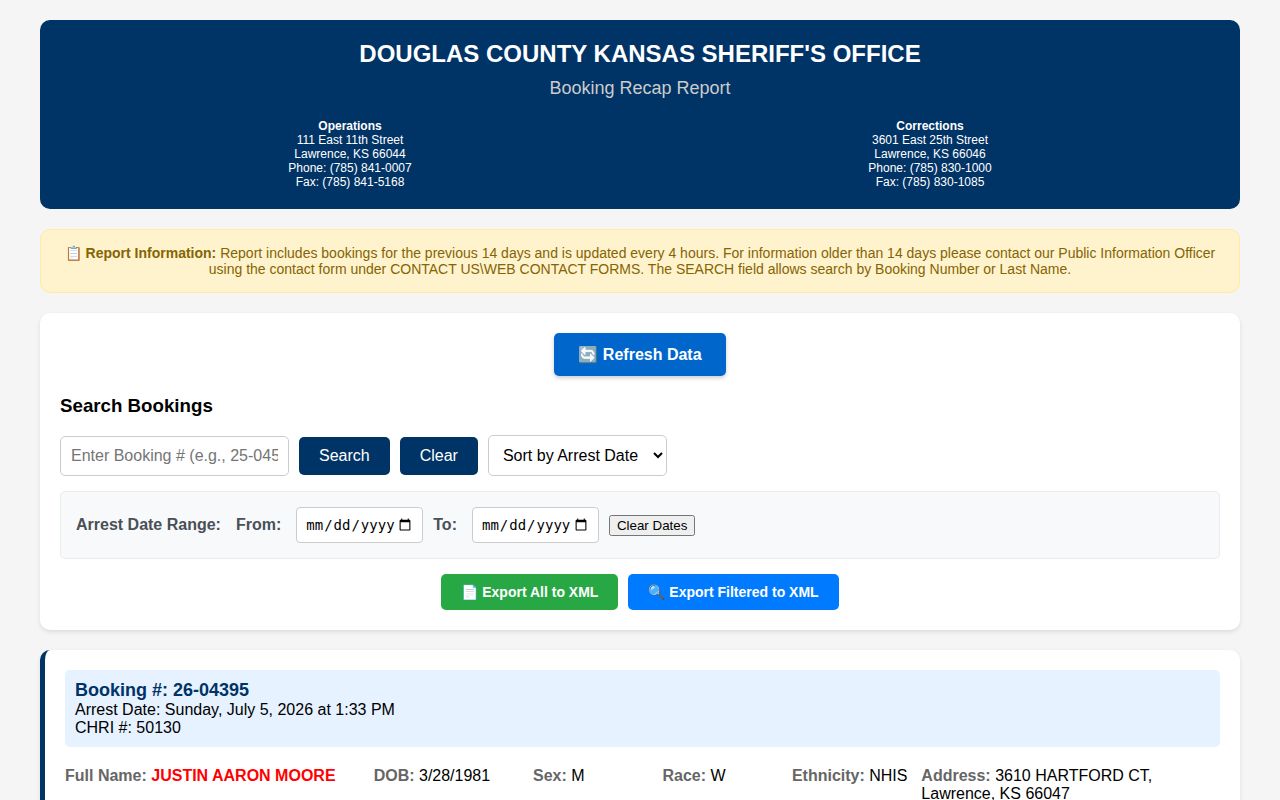
The image shows why the report is rich in booking context yet cannot stand in for a Douglas County release ledger.
Can the arrest-date filter create a 72-hour release list? No. It narrows when people were booked, so it misses old bookings that ended during the chosen release window.
Douglas County Release Record Fallback
When the comparison remains unresolved, seek the record created by the responsible office. DGSO holds DCCF booking and release events. The Clerk holds the court case. KDOC holds state movement, release, discharge, and supervision records. Federal and immigration systems require their own channels.
DGSO’s NextRequest portal is labeled for accident and offense reports, so its application to jail release events is not guaranteed. Contact the Public Information Officer at 785-832-5113 or Corrections at 785-830-1000 for routing. A focused request should give the name and aliases, date of birth, CHRI or Inmate number, booking number, date range, agency, court and case number, and the exact release fields sought.
Ask for admission date and time, release date and time, release type, and destination. If an office denies or delays access, Kansas open-records procedure allows a response explaining when and where records will be available or the legal basis for denial. No routine DGSO fee schedule, production time, or release-record retention period was verified, so confirm those terms before ordering.
Douglas County Release System Boundaries
A three-day search can cross systems. For county custody, use DGSO, VINE, and the court. If sentencing moved the person to state prison, search KASPER and read status, location, sentence, and movement data together. KASPER is not a complete source for people whose custody ended after only a short county-jail stay.
For a federal sentence, use the BOP Inmate Locator. For a possible immigration transfer, use the ICE Online Detainee Locator and contact ICE ERO if the result is unclear. A BOP or ICE no-result is not enough to rule out custody. USMS pretrial detainees may not appear in BOP, while ICE data can lag or be limited.
- Still in custody
- The current source identifies the person and custodian.
- County release
- The DCCF event states that county custody ended and gives the reason or destination.
- Transfer
- The person leaves Douglas County custody but enters or remains in another system.
- State discharge
- KASPER may show that the KDOC sentence and supervision relationship ended.
A broader named-person inquiry can follow the Douglas County release-record search through old court cases and agency records after public report windows expire.
Kansas VINE provides a useful bridge between those systems, but only for data supplied by participating agencies. Match the Douglas CHRI identifier and named custodian. If the result reports a change, confirm its meaning with the agency rather than converting it into a release reason. Delayed or missed notices remain possible, and urgent safety needs should go to law enforcement or victim-service channels.
Older Douglas County events require durable records. Booking Recap directs questions beyond its display window to the Public Information Officer. The proper district or municipal court can establish the disposition, while a narrow jail request can seek the operational event. Together, those sources answer both why custody was authorized to end and when staff recorded the actual departure or transfer.